

Scale-up
Bandwidth inside the node and rack. GPU-to-GPU fabrics, package-level optics, power and thermal density, and whether co-packaged or near-packaged designs can be manufactured, qualified, and serviced at volume.

OptiCom Advisors is an independent firm focused on optical communications and photonics. The work is technical due diligence, architecture assessment, and market strategy — for people who have to commit capital, set a product roadmap, or take share.
The core of the work is AI/ML datacom: how optical components and modules are designed, qualified, sourced, and deployed in scale-up, scale-out, and scale-across fabrics, including optical circuit switching. The same reading of the inner workings and driving forces of that layer informs product roadmaps and competitive position. It extends, where the diligence requires it, to telecom line systems, amplifiers, and ROADMs.

Mandate
A clear, operator-grade reading of the optical layer, so investment, product-roadmap, and market decisions rest on what can be built, sourced, and deployed — not on a slide.
Three distinct problems, often conflated. Each has a different optical answer, a different vendor set, and a different risk profile.
Bandwidth inside the node and rack. GPU-to-GPU fabrics, package-level optics, power and thermal density, and whether co-packaged or near-packaged designs can be manufactured, qualified, and serviced at volume.
Adding nodes and racks. 800G through 3.2T cluster networks, rail-optimized and fat-tree topologies, pluggable versus onboard optics, LPO and LRO, and optical circuit switching as an alternative to electrical packet fabrics.
Connecting clusters across buildings, campuses, and metro distances. Coherent pluggables, DCI, optical circuit switching between sites, and — where the traffic leaves the campus — the telecom line.
OCS

Optical circuit switching is a first-order question in AI/ML scale-out. MEMS and liquid-crystal fabrics sit in the cluster as an alternative to electrical packet switching: lower power, a different radix and insertion loss, and a control plane that is not a router.
The diligence is whether a given OCS can reconfigure in the window the job needs, survive at hyperscale, and be manufactured and supported by a vendor an operator will actually buy. It belongs in the same conversation as CPO, LPO, and the 1.6T pluggable — not as a niche transport footnote.
CPO, NPO, LPO, and LRO are not interchangeable labels. They encode different electrical reach, DSP placement, power, and service models.
CPO
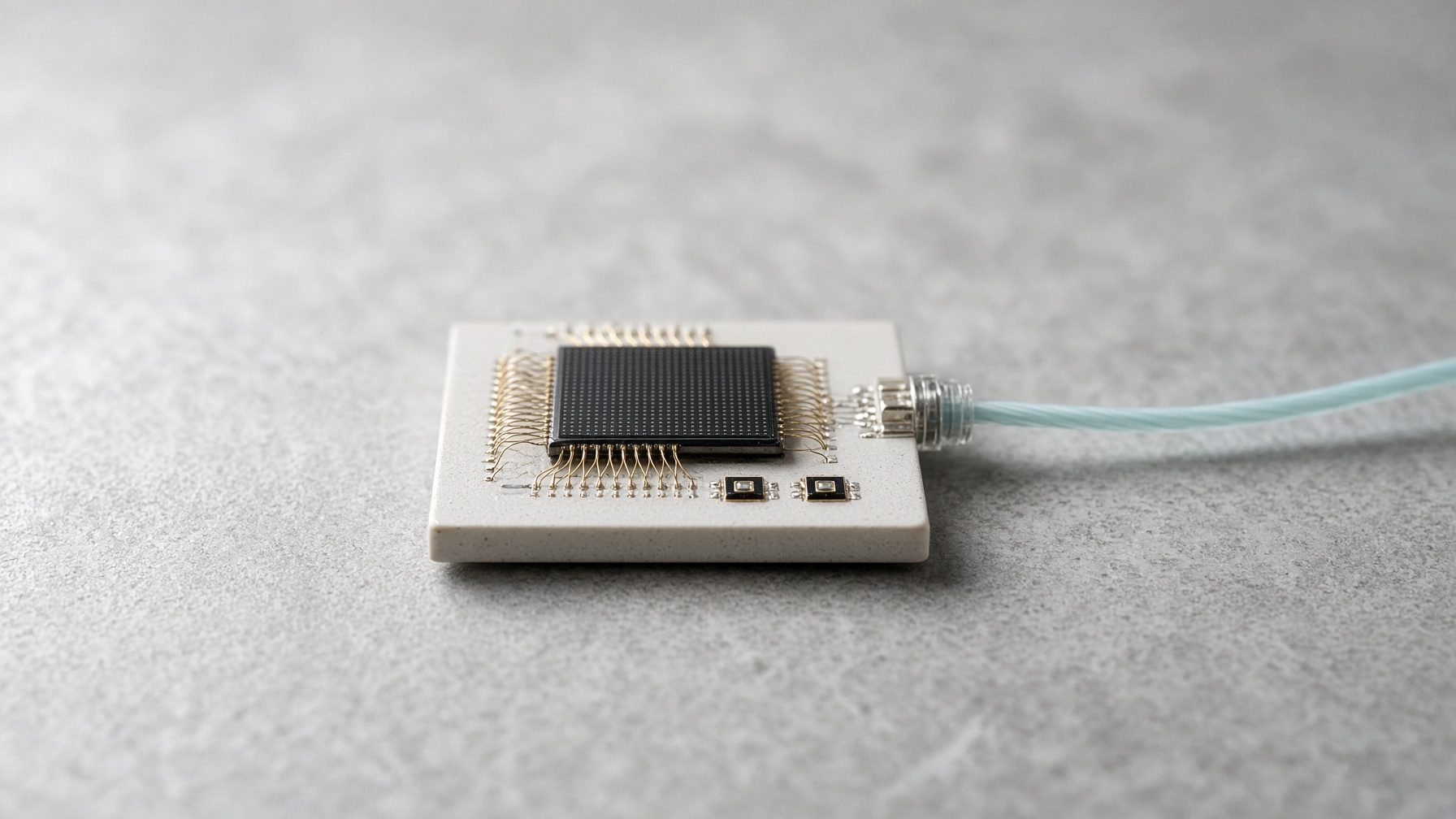
Optics in the same package as the switch or accelerator ASIC. Shortest electrical reach and highest density; the open questions are yield, rework, laser integration, and a still-forming multi-vendor ecosystem.
NPO
Optics on a nearby substrate or module rather than in the ASIC package. A less aggressive path to short electrical reach, with more conventional serviceability and a different yield profile.
LPO
A pluggable module without an onboard DSP. Power and latency improve if the host SerDes can close the link. Reach, interoperability, and host-side equalization are the constraints that determine real deployment.
LRO
DSP on the transmit path and a linear receive path. A hybrid that some operators treat as more deployable than full LPO, at a different power and interoperability point.
Where the same optical layer meets the telecom network: line systems, amplifiers, ROADMs, and multi-rail OLS.

OLS
The DWDM optical line — EDFAs, Raman, multiplexers, supervisory, and the fiber they light. Open versus integrated architectures, gain spectrum, and what an operator will actually qualify.
ROADM
Wavelength routing in metro and long-haul networks. Degree count, colorless, directionless, and contentionless designs, and the difference between an add/drop node and an express core.
Multi-rail OLS
Independent optical rails on a shared line-system platform. How capacity scales without a new cable, how AI DCI and telecom traffic can share fiber, and which vendors can actually ship a multi-rail architecture.
Assembly geography, laser origin, and qualification paths are not independent of U.S. policy. Export controls, sourcing rules, and national-security review of optics in U.S. networks change who can sell, who must dual-source, and how long a bill of materials takes to clear.
The work is to state how a product or a supply plan best aligns with that policy. OptiCom Advisors treats this as part of technical diligence, not as a separate political commentary.
Confidential discussions with investors, operators, and corporate development teams.